Economy vs Standard vs Pro Soap Production Lines | STING
Choosing the right soap production line is an important decision for any soap manufacturer. The right equipment can improve production efficiency, maintain product consistency, and support future business growth.
In this soap production line comparison, we explore Economy, Standard, and Pro configurations to help you choose the right solution for your business, whether you manufacture laundry soap or toilet soap.
1. Why Compare Soap Production Lines?
Different soap factories have different production goals and budgets. A small business may need essential equipment with a lower initial investment, while an established manufacturer may require advanced automation and higher production output.
Before choosing a soap making machine or complete production line, consider production capacity, automation level, equipment configuration, labor requirements, and future expansion plans.
2. Economy vs Standard vs Pro: Key Differences
Economy Soap Production Line
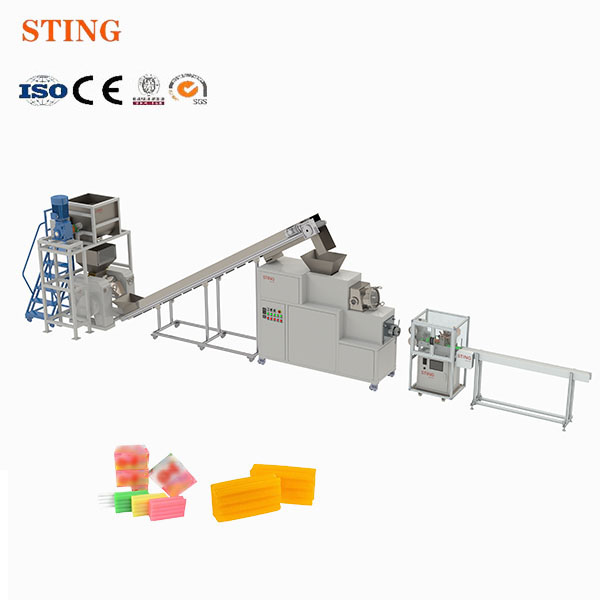
Economy soap production lines are tailor-made for small-scale startups. With simplified equipment and affordable price, it features small but profitable investment, ideally suited for producing lightly colored soaps with basic formulations which do not need a lot of powder additives such as talcum powder, titanium dioxide, zeolite, etc. Therefore, it enables small businesses to enter the soap market quickly and open sales channels cost-effectively with high ROI (Return on Investment) and a short payback period.
Standard Soap Production Line
Standard soap production line, equipped with two three-roll mills which are capable of fuller and better material refinement. This processing enables various additives such as flavors, pigments, etc. in the raw materials to be more evenly mixed and the produced soaps to manifest a smooth texture and even color, making it suitable for clients who want to produce mid-to-high-end quality soaps.
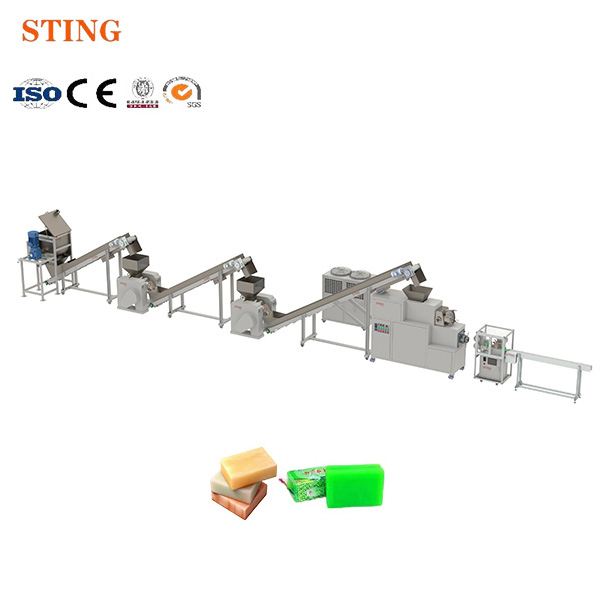
Pro Soap Production Line
Pro soap production line serves as our premium production line. It is well-equipped and incorporates a three-roller mill and a simplex refiner with built-in filtration screen to remove iron contaminants and other impurities from raw materials. It also delivers exceptional grinding performance that various additives, flavors, pigments, etc. in the raw materials can be mixed more evenly, and the soap produced is smooth and uniform in color. Consequently, it is not only ideal for customers who want to produce medicated soaps and beauty soaps requiring premium quality, but also a suitable match for cosmetics and pharmaceutical manufacturers seeking GMP-certified compliance.

3. Soap Production Line Comparison Table
| Feature | Economy | Standard | Pro |
|---|---|---|---|
| Initial investment | Lower | Medium | Higher |
| Automation | Basic or semi-automatic | More automation options | Advanced integration options |
| Production capacity | Model-dependent | Model-dependent | Model-dependent |
| Equipment integration | Essential stages | More integrated processes | Greater integration potential |
| Labor requirements | May be higher | Configuration-dependent | Potentially lower |
| Best suited for | Start-ups | Growing manufacturers | Large-scale operations |
Note: These are general comparison categories, not fixed technical specifications. Actual capacity, included machines, and automation depend on the selected equipment and project requirements.
4. Which Soap Production Line Is Right for You?
Choose Economy if:
-
You are starting a soap manufacturing business.
-
Your initial budget is limited.
-
Your production requirements are relatively modest.
Choose Standard if:
-
Your business is growing.
-
You want a balance between investment and efficiency.
-
You need more integrated production processes.
Choose Pro if:
-
You have substantial production requirements.
-
Automation and process integration are priorities.
-
You are planning long-term factory expansion.
The best choice depends on your actual output target, product specifications, available space, and operating budget—not simply the equipment category.
5. What Should You Consider Before Buying?
Before requesting a quotation, prepare the following information:
-
Soap type: laundry soap, toilet soap, or other solid soap products.
-
Target production capacity in kg/h or tonnes per day.
-
Raw materials and finished soap specifications.
-
Required equipment, including plodder, cutting, stamping, and packaging.
-
Automation preferences and factory utilities.
-
Installation requirements and future expansion plans.
Providing these details helps your equipment supplier recommend a suitable configuration.
6. Explore STING Soap Manufacturing Solutions
STING offers soap machinery and production equipment for manufacturers seeking individual machines or complete production solutions.
From soap processing and extrusion to cutting, stamping, and packaging, equipment selection should match your product requirements and production goals.
Looking for the right soap production line?
Contact STING to discuss your project and request a customized quotation.
Frequently Asked Questions
Q1. What is the difference between Economy, Standard, and Pro soap production lines?
The main differences typically involve investment, automation, equipment integration, and production requirements. Exact specifications depend on the selected configuration.
Q2. Which soap production line is best for a small business?
An Economy configuration may suit a start-up with modest output requirements. The final choice depends on budget, product type, and future growth plans.
Q3. Can one production line manufacture laundry soap and toilet soap?
Some equipment can handle different soap products, but compatibility depends on raw materials, processing requirements, and machine configuration. Confirm suitability with the manufacturer.
Q4. How do I compare production capacity?
Compare rated output using consistent units such as kg/h. Confirm whether the figure applies to an individual machine or the complete line, and ask about expected finished-product output.
Q5. Does an automatic soap production line require fewer workers?
Automation may reduce manual handling, but staffing requirements depend on equipment integration, packaging, material handling, and quality control.
Q6. How can I request a quotation from STING?
Provide your soap type, target capacity, finished product specifications, required equipment, and factory conditions. STING can then assess your requirements and discuss a suitable solution.
Conclusion
A successful soap production line comparison should consider more than purchase price. Evaluate automation, capacity, product compatibility, operating costs, and future expansion before making your decision.
Contact STING to explore a soap manufacturing solution tailored to your business.
Soap Packaging Machines for Industrial Production