Soap Packaging Machines for Industrial Production
In the soap manufacturing industry, packaging is an essential part of the production process. A reliable soap packaging machine helps manufacturers package finished soap bars efficiently, maintain consistent product presentation, and prepare products for storage, distribution, and retail sales.
For factories producing laundry soap, toilet soap, and other bar soap products, choosing the right packaging equipment can improve production efficiency and reduce manual handling. Whether you operate a small soap factory or a large-scale manufacturing plant, understanding different soap packaging solutions is important for building an efficient production line.
In this guide, we explain how industrial soap packaging machines work, the main types available, and the key factors to consider when selecting packaging equipment for your factory.
1. What Is a Soap Packaging Machine?
A soap packaging machine is industrial equipment designed to wrap or package finished soap products after they have been processed, cut, and stamped.
Depending on the soap type and packaging requirements, the machine may use paper, plastic film, cartons, or other suitable packaging materials. Some machines perform individual wrapping, while others are designed for cartoning, bundling, or integration with automated packaging lines.
A suitable soap packaging machine can help manufacturers:
- Improve packaging speed and production consistency.
- Reduce repetitive manual packaging operations.
- Maintain a neat and professional product appearance.
- Reduce packaging errors and material waste when properly configured.
- Integrate packaging operations with upstream soap production equipment.
The best solution depends on the soap bar dimensions, packaging material, required output, and the factory's overall production layout.
2. Types of Soap Packaging Machines for Industrial Production
Different soap products require different packaging methods. Manufacturers should select equipment according to their product specifications and target markets.
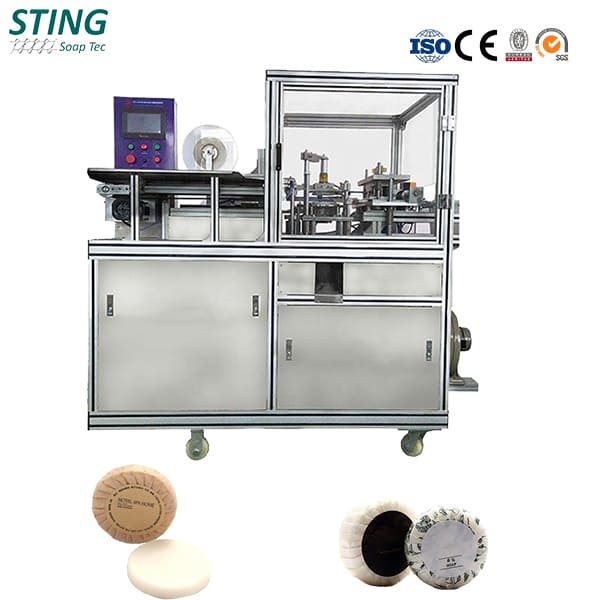
2.1 Pleat Wrapping Machines
Pleat wrapping machines are designed to wrap individual soap bars using suitable packaging materials.
Depending on the machine configuration, wrapping may use paper, film, or other materials compatible with the product and packaging design.
These machines are commonly considered by manufacturers producing toilet soap, beauty soap, and retail bar soap.
When selecting a wrapping machine, consider the dimensions of the soap bars, the type of wrapping material, the required packaging appearance, and the expected production speed.
2.2 Flow Wrapping Machines
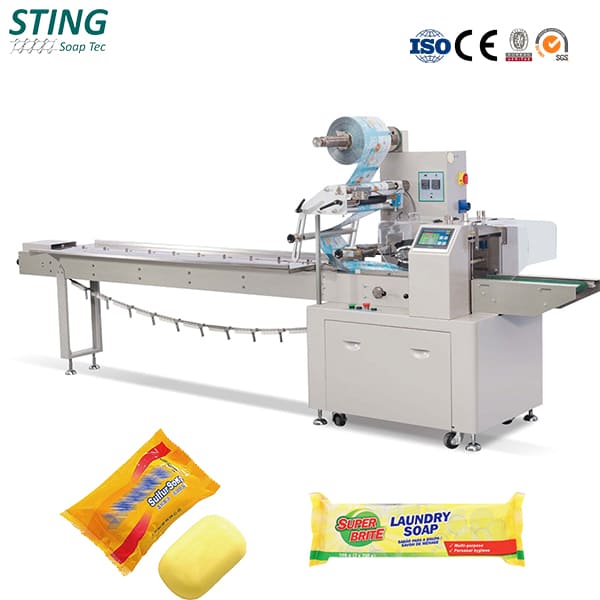
Flow wrapping machines package products in flexible film, typically forming a sealed package around each item.
They may be suitable for certain bar soap products, multipacks, or other packaging formats, depending on the product dimensions and machine configuration.
Before purchasing a flow wrapping machine, manufacturers should confirm that the equipment can handle their soap bar shape, film specifications, sealing requirements, and target output.
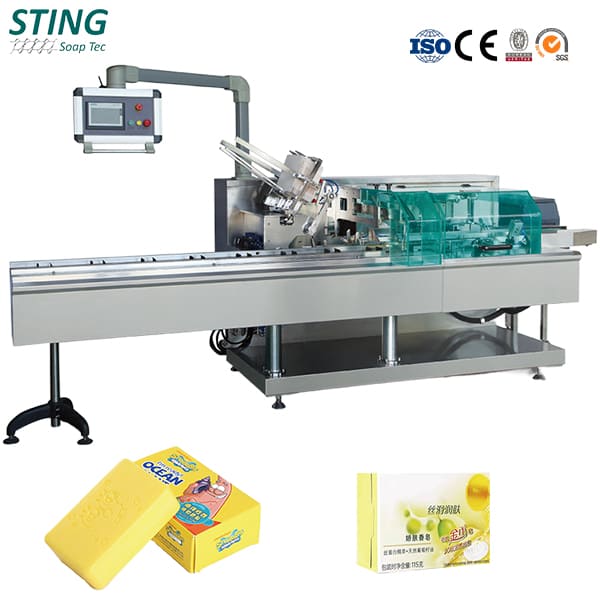
Cartoning machines place products into cartons or folding boxes. They are useful for soap products sold in individual retail boxes or multi-bar packages.
For manufacturers supplying supermarkets, distributors, or private-label customers, carton packaging may support product differentiation and brand presentation.
Cartoning equipment can be operated as a separate packaging station or integrated into a larger automated packaging system.
3. How Does a Soap Packaging Machine Work?
The packaging process varies according to the equipment used, but a typical industrial workflow includes the following stages.
Step 1: Soap Feeding
Finished soap bars are transferred from the cutting or stamping section to the packaging station.
The feeding system should accommodate the soap dimensions and maintain a consistent product flow.
Step 2: Product Positioning
The machine aligns the soap bars before wrapping or placing them into cartons.
Accurate positioning helps maintain consistent package appearance and reduces feeding errors.
Step 3: Packaging Material Feeding
The packaging material is supplied to the machine according to the selected packaging method.
Material specifications, roll dimensions, and feeding settings should match the machine's design.
Step 4: Wrapping or Cartoning
The soap bars are wrapped in the selected material or placed into cartons. Depending on the machine, this stage may include folding, sealing, or other packaging operations.
Step 5: Inspection and Collection
Finished packages can be checked for appearance, sealing quality, labeling, and other relevant requirements.
The packaged products are then collected for secondary packaging, storage, or shipment.
For a complete industrial soap factory, the packaging process should be coordinated with the capacity of the upstream soap finishing line.
4. Key Factors When Choosing a Soap Packaging Machine
Selecting a suitable soap packaging machine requires more than comparing the advertised machine speed. Manufacturers should evaluate several factors before making a purchasing decision.
4.1 Soap Type and Product Dimensions
Laundry soap and toilet soap may differ in size, shape, surface characteristics, and packaging requirements.
Provide the supplier with representative product samples or detailed dimensions. Confirm whether the machine can handle all intended soap specifications and how quickly it can be adjusted between products.
4.2 Required Packaging Capacity
The packaging machine must be capable of handling the actual output of the production line.
For example, a factory producing several hundred kilograms of soap per hour needs to evaluate both the upstream production capacity and the number of bars that must be packaged per minute.
The calculation should consider the weight of each soap bar, product variation, planned operating hours, and expected equipment efficiency.
A machine's advertised maximum speed should not automatically be treated as its sustained production output.
4.3 Packaging Materials
Different packaging materials require different feeding and sealing configurations.
Before selecting equipment, confirm compatibility with the intended paper, film, carton, or other packaging material. Material thickness, dimensions, sealing characteristics, and print requirements may affect machine performance.
4.4 Automation Level
Some factories prefer semi-automatic packaging equipment, while others require fully automated packaging lines.
The decision depends on labor availability, budget, output requirements, product variety, and the degree of integration required with existing machinery.
For a factory expanding its production capacity, it may be worth evaluating whether the packaging system can accommodate future output increases.
4.5 Maintenance and Technical Support
Industrial packaging equipment should be easy to maintain and supported by appropriate technical documentation.
Ask about spare parts, routine maintenance, operator training, installation requirements, and after-sales support.
These considerations are especially important for international buyers who need to coordinate equipment installation and maintenance across different countries.
5. Integrating Packaging Equipment with a Soap Production Line
A soap packaging machine should not be selected independently of the rest of the production process.
In a typical bar soap manufacturing facility, the production workflow may include mixing or refining, extrusion, cutting, stamping, and packaging. The exact sequence depends on the soap formulation and manufacturing process.
If the packaging section operates more slowly than the upstream equipment, finished soap may accumulate before packaging. If packaging capacity is substantially higher than production output, the additional capacity may not deliver meaningful benefits.
When planning a new factory or upgrading an existing facility, manufacturers should evaluate:
- Actual output from the soap finishing section.
- Soap bar dimensions and packaging formats.
- Required packaging speed and operating schedule.
- Product transfer and accumulation between machines.
- Available factory space and utility requirements.
- Future product varieties and capacity expansion plans.
Working with an equipment supplier that understands the overall soap production process can help manufacturers select compatible machinery and plan a more efficient production layout.
6. Why Choose the Right Soap Packaging Solution?
The right packaging solution helps manufacturers align production efficiency with product quality and market requirements.
For factories supplying multiple markets, packaging flexibility may also be important because customers can require different bar sizes, printed materials, carton designs, and labeling specifications.
Rather than selecting equipment based on price alone, buyers should compare the complete technical configuration, production capacity, packaging compatibility, maintenance requirements, and supplier support.
For a new soap factory, packaging equipment should be included in the overall production line planning process. For an existing factory, it may be more practical to upgrade the packaging section after identifying the current production bottleneck.
7. Get the Right Soap Packaging Solution for Your Factory
Choosing an industrial soap packaging machine begins with understanding your product, output requirements, and packaging specifications.
Before requesting a quotation, prepare the following information:
- Type of soap: laundry soap, toilet soap, or other bar soap.
- Soap bar dimensions and individual weight.
- Required packaging material and package format.
- Target production capacity.
- Required level of automation.
- Factory location and installation requirements.
STING provides soap manufacturing machinery and production line solutions for industrial applications. If you are planning a new soap factory or upgrading an existing production line, contact the STING team to discuss your production requirements and evaluate suitable equipment configurations.
Request a Quote to discuss your soap production project and packaging requirements.
Frequently Asked Questions (FAQ)
1. What is a soap packaging machine used for?
A soap packaging machine wraps or packages finished soap bars using suitable materials such as paper, flexible film, or cartons. Depending on the configuration, it may also support product feeding, counting, cartoning, and secondary packaging.
2. Which soap packaging machine is suitable for laundry soap?
The suitable machine depends on the laundry soap's dimensions, packaging format, material requirements, and production output. Manufacturers should confirm these specifications with the equipment supplier before selecting a machine.
3. Can a soap packaging machine be integrated with an existing production line?
Yes. Many packaging systems can be integrated with existing production equipment, provided that the product transfer method, machine interfaces, output capacity, and available space are compatible.
4. How do I calculate the required packaging capacity?
Start with the production line's actual output and the weight of each soap bar. For example, a line producing 300 kg/h with 100 g soap bars produces approximately 3,000 bars per hour, or 50 bars per minute, before accounting for production variation and downtime.
The packaging machine should be selected with sufficient practical capacity for the intended operating conditions.
5. What information is needed to request a quotation?
Prepare the soap type, product dimensions, individual weight, packaging material, required output, automation preferences, and installation requirements. Product samples, drawings, or photographs can also help the supplier evaluate equipment compatibility.
6. Can one packaging machine handle different soap sizes?
Some machines support multiple product sizes through adjustable settings or interchangeable parts. The available adjustment range and changeover time depend on the machine design, so buyers should confirm compatibility with all intended soap specifications.
7. How can I reduce packaging bottlenecks in a soap factory?
Compare the actual output of the cutting, stamping, and packaging sections. Check whether product feeding, changeovers, material supply, or manual handling limits the overall line output. Improving coordination between machines may be more effective than purchasing a faster packaging machine alone.
Economy vs Standard vs Pro Soap Production Lines | STING
How to Select a Soap Plodder Machine